
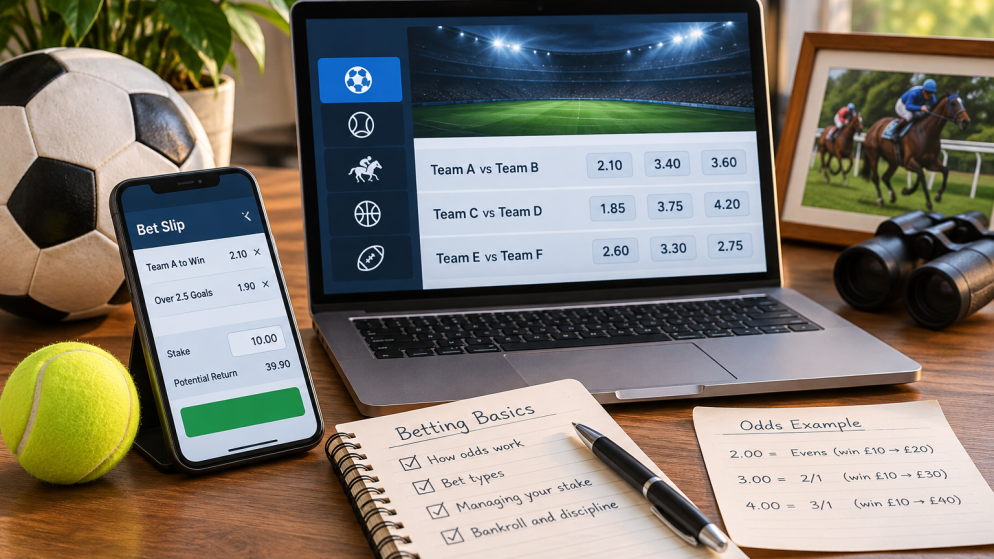
Walking into the bookies for the first time, or logging into a betting app, can feel like you’ve stumbled into a foreign language class. Numbers like 4/1, 11/10, or 4/6 are everywhere, alongside odd phrases like “accumulator,” “each-way,” or “the bookie’s margin.”
Here’s the simple version: sports betting is putting money behind your prediction. If you’re right, you win money based on the odds. If you’re wrong, you lose what you bet.
This guide breaks down the basics across different sports and markets, so you can place your first bet with confidence instead of confusion.
Understanding Betting Odds
Odds tell you two things: how likely a bookmaker thinks something is to happen, and exactly how much you’ll win if you’re right.
UK bookmakers use fractional odds (like 4/1) or decimal odds (like 5.0). Most apps let you switch between them in settings.
Fractional odds show [what you win] / [what you bet]. There are three types of fractional odds in sport betting:
- Odds against (like 4/1): The top number is bigger. You win £4 for every £1 staked. Stick a tenner on and you get back £50 (£40 profit plus your £10 stake).
- Odds on (like 1/2): The top number is smaller. This signals a heavy favourite. You win £1 for every £2 staked. A tenner gets you back £15 (£5 profit plus your stake).
- Evens (1/1): Win equal’s stake. £10 returns £20.
Decimal odds show your total return including stake. Many beginners find decimals easier because you just multiply your stake by the number. A £10 stake at 5.0 returns £50 total.
| Fractional | Decimal | £10 Returns | Implied Probability |
| 1/2 | 1.50 | £15 | 66.7% |
| 1/1 | 2.00 | £20 | 50% |
| 4/1 | 5.00 | £50 | 20% |
Returns include your original stake. Implied probability shows what the odds suggest, not necessarily what will actually happen.
Top Tip: Try both formats and see which clicks. There’s no right answer, just what makes sense to your brain.
How to Place a Sports Bet
Placing a bet is straightforward once you know the steps:
- Pick a licensed bookmaker and verify your age (they’ll ask for ID)
- Find your event (football, tennis, horse racing, whatever you fancy)
- Choose a market (match winner, total goals, race winner)
- Check the odds and work out your potential return
- Enter your stake (the amount you’re prepared to lose)
- Review and confirm your betting slip
If your bet wins, you get paid at the odds you accepted. If it loses, your stake’s gone. Some bets get voided if a match is abandoned or a player withdraws, in which case you get your stake back.
Common Types of Sports Bets
Single Bet: One pick on one event. If it wins, you get paid. Dead simple.
Accumulator (Acca): Multiple picks rolled into one bet. The odds multiply together for potentially huge returns, but every single pick must win. One loss and the whole thing collapses.
Example: Back four teams to win at 2/1 each and you’re looking at combined odds around 80/1. A tenner could return £810, but all four teams need to come through.
Each-Way: Popular in horse racing and golf. Your stake splits into two separate bets: one for a win, one for a place (usually top 2-4 depending on field size). If your pick wins, both bets pay. If it only places, you lose the win bet but get a fraction of the odds on the place.
System Bets: These cover multiple accumulator combinations (Trixies, Yankees, Lucky 15s). They’re more advanced and give you partial returns even if some picks lose.
Popular Sports Betting Markets
Markets describe what you’re actually predicting. Different sports offer different options, but these are the staples across football, tennis, cricket and more.
Match Result (1X2): Predict the outcome at full time. Home win (1), draw (X), or away win (2). This us standard stuff for football and any sport where draws happen. Backing a heavy favourite like Manchester City at home might only pay 1/4, while an underdog away win could offer 8/1 or more.
Both Teams to Score (BTTS): Will both teams score at least once? It’s popular because you don’t need to pick a winner, just whether both sides find the net.
Over/Under Goals: Will the total goals scored be over or under a set number (usually 2.5 in football)? Over 2.5 wins if there are 3+ goals. Under 2.5 wins if there are 2 or fewer.
Match Winner (No Draw): Pick the winner in sports where draws are rare or impossible. Tennis, rugby, American football. Two outcomes, no middle ground.
Handicap Betting: Levels the playing field by giving the favourite a virtual disadvantage (like -1.5 goals) or the underdog a head start. If you back Man City at -1.5 and they win 2-0, your bet wins (2 – 1.5 = 0.5). But if they only win 1-0, your bet loses (1 – 1.5 = -0.5).
Correct Score: Predict the exact final score. The odds are much higher because there are loads of possible outcomes, but it’s also much harder to nail.
Essential Betting Terms
Before you start browsing markets, it helps to know the basic language. Your stake is the amount you’re risking on a bet and what you lose if it goes wrong. Your returns are the total payout if you win, including your original stake plus profit.
A favourite is the selection the bookmaker considers most likely to win. Lower odds, more likely outcome. The underdog is the opposite. Less likely to win, higher odds, bigger payout if they pull it off. When a bet is voided, it’s cancelled and your stake comes straight back. This happens if a match is abandoned, a player withdraws or there’s a market error. When a bet is settled, the bookmaker has called the result and either paid out your winnings or taken your stake.
The Principles of Bankroll Management
Keeping your betting budget under control is what separates entertainment from stress. The first step is setting a bankroll, which is your fixed betting pot. Only use money you’re comfortable losing. Never touch rent money, bill money, or anything else you actually need. Think of it like your entertainment budget for a night out.
Once you’ve got your bankroll sorted, work out your unit size. This is your standard bet amount. Lots of experienced bettors use 1-2% of their total bankroll per bet. It’s not a magic safety net, but it does stop you burning through your budget on a bad Saturday.
If you’ve got a £100 bankroll, your unit size would be £1-£2 per bet. That way you can spread your money across multiple bets instead of blowing it all in one go.
Had a rough day? The worst thing you can do is lump on a massive bet trying to get it all back. Never chase losses. Accept the loss, stick to your plan, and remember there’s no such thing as a sure bet.
Here’s the uncomfortable truth: you can lose your entire bankroll even if you follow every rule in the book. No betting strategy guarantees profit.
If you’re betting more than you can afford or feeling stressed about it, stop and get support. For more guidance on staying in control, visit our responsible gambling page.
Live Betting vs Pre-Match Betting
Pre-match betting is placing your bet before the event starts. It’s traditional sports betting at its simplest, and it gives you the widest range of markets to pick from. Odds are set in advance based on form, team news and whatever else the bookmaker factors in.
Live betting, or in-play, lets you bet while the action is happening. Odds shift constantly based on what’s going on in the game. If a football team goes 1-0 down, their odds to win will get longer. It’s exciting stuff, but it’s also riskier for beginners.
Fast-moving betting odds and the heat of the moment can push you into bets you wouldn’t make with a clear head. Get some experience with pre-match markets first before you start betting in-play.
Choosing a Bookmaker
Before you place any bets, check the bookmaker is legit and has proper player protections in place. Make sure they hold a valid licence. In Great Britain, the UK Gambling Commission requires operators to verify your age and identity before you can gamble. Licence details are usually in the site footer.
Legit bookmakers will ask for ID (passport or driver’s licence) when you register or before your first withdrawal. It’s annoying but it’s the law, and it’s there for good reason.
Beyond the basics, look for proper player protection tools like deposit limits, loss limits, time limits and self-exclusion options. If a bookmaker makes these hard to find or awkward to use, that’s a red flag.
Think about the features that actually matter to you. Does the site cover the sports you care about? Can you bet in-play? Is there a cash-out option? Does the app actually work? What payment methods do they take?
If you’re looking for a comprehensive breakdown of available platforms, our guide to betting sites not on GamStop covers features, licensing and player protections across different operators.
Some modern betting sites also accept cryptocurrency for deposits and withdrawals—explore our guide to crypto casinos not on GamStop for these options.
Quick Checklist Before Betting
Before you hit confirm:
- Know your payout: Work out exactly what you’ll win if the bet comes in
- Check the terms: Standard football bets count 90 minutes plus stoppage only (extra time doesn’t count unless stated)
- Stay within budget: Only stake what you’re prepared to lose
- Understand the risk: Every bet can lose
Sports betting should be fun, not a way to pay the bills or earn money. Set limits and walk away if it stops being enjoyable.
Frequently Asked Questions
What happens if a match is postponed?
If it’s rescheduled within 24-48 hours, most bookmakers keep the bet live. If it’s cancelled completely, the bet gets voided and you get your stake back.
Do football bets include extra time?
Nope. Standard bets cover 90 minutes plus stoppage time only, unless the market specifically says otherwise.
What is an accumulator?
Multiple picks combined into one bet. The odds multiply together, but every single pick must win. One failure and the whole thing loses.
Can I cancel a bet after I’ve placed it?
Generally no. Some bookmakers offer “cash out” to settle early for a reduced payout, but that’s not the same as cancelling.
What does “void” mean?
A cancelled bet where you get your stake back. Happens if a match is abandoned or there’s an error with the market.